

Direct SQL
It is basedb’s reason for being: your tables are real tables. Any PostgreSQL client reads them under their names.
| Object | Physical name | Example |
|---|---|---|
| Base | a schema b_<tenant>_<nom> | b_t4z56fq_ventes |
| Staging environment | the schema, with a suffix | b_t4z56fq_ventes_recette |
| Table | its slugified name | opportunites |
| Field | its slugified name | echeance |
| Relation | <table cible>_id | clients_id |
| SQL view | its technical name, in the base’s schema | factures_a_encaisser |
Each base’s API and MCP documentation page gives them all, and \d in psql shows the
descriptions (COMMENT ON).
In the interface
Section titled “In the interface”The + in the tab bar, or the base’s ⋯ menu → SQL query: an editor with syntax highlighting and completion, whose result is shown in the same grid as your tables.
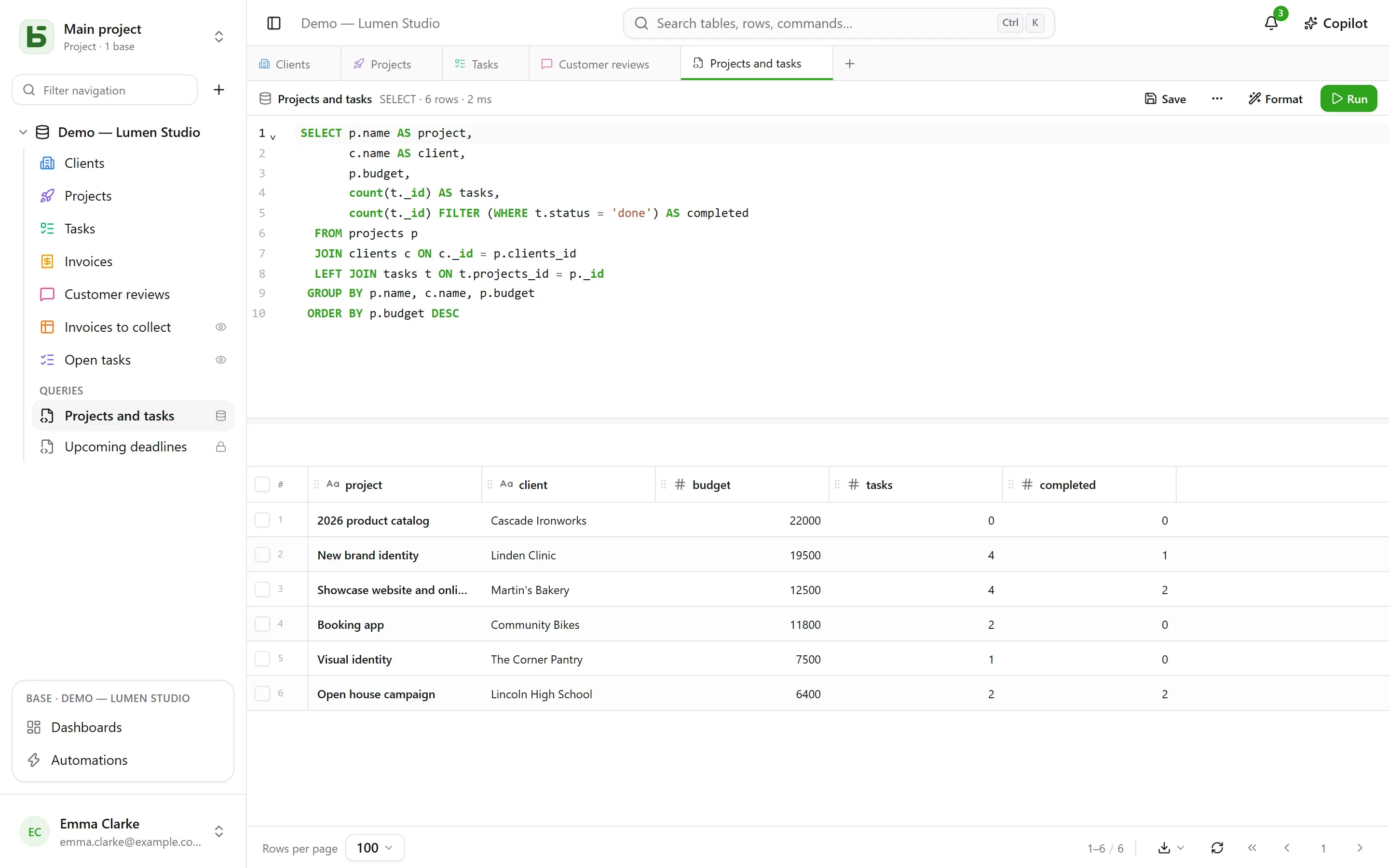
- Everyone reads there with their own permissions: the Manage level has the whole base, writes included; other members write read-only SQL, where a closed table does not exist and a hidden field disappears.
- A query is saved under the tables — for yourself, for the whole base or for groups —, and
becomes, if you want, an SQL view: a real PostgreSQL view, filed among the tables and
readable from
psql.
Everything is detailed in SQL queries and views.
From psql
Section titled “From psql”With the provided docker-compose.yml, PostgreSQL is published on 127.0.0.1:5432:
psql "postgres://basedb:<POSTGRES_PASSWORD>@localhost:5432/basedb"SET search_path = b_t4z56fq_ventes;
SELECT o.nom, o.montant, c.nom AS clientFROM opportunites oJOIN clients c ON c._id = o.clients_idWHERE o.statut = 'gagne';This account is the base’s owner: it reads everything, and basedb’s permissions do not apply to
it. For a BI tool, create a separate role with its own GRANTs instead. If a table carries a
row rule, PostgreSQL applies row-level
security to it: such a role sees no rows there without the BYPASSRLS attribute or a policy of
its own.
Writing in SQL
Section titled “Writing in SQL”It is allowed. Constraints (single selects, relations, URLs, required) are enforced by PostgreSQL and reject an invalid value, just as in the interface. And the write is recorded in the history: the history shows it as “Direct SQL session”, with the session that made it, and it can be undone like any other.
basedb is open-source software by Eodia, an AI-native software studio.